
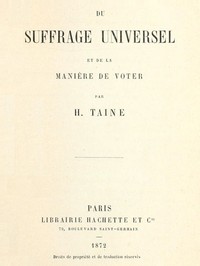
Du suffrage universel et de la manière de voter by Hippolyte Taine
First, let's clear something up: this isn't a novel. It's a political essay from 1872, written after France's defeat in the Franco-Prussian War and the chaos of the Paris Commune. Taine was trying to figure out why French democracy seemed so unstable.
The Story
There's no plot in the traditional sense. Instead, Taine lays out his argument like a detective solving a case. He starts with a big idea: universal suffrage—letting all (male) citizens vote—is a great principle. But then he asks, 'What good is the right to vote if the system around it is flawed?' He zooms in on the practical stuff: how ballots are designed, how information reaches voters, and how people actually make decisions in the voting booth. He paints a picture of voters who are often poorly informed, swayed by passion or clever slogans, and voting in a system that doesn't always encourage careful thought.
Why You Should Read It
What's amazing is how current it feels. When Taine talks about the 'noise' of political campaigns drowning out real debate, or the challenge of making a good choice with limited information, you could be reading a blog post from last week. It's a sobering reminder that the mechanics of democracy—the boring, technical parts—are what protect its spirit. This book doesn't give easy answers, but it asks the right, uncomfortable questions.
Final Verdict
This is for the curious reader who loves history and politics but hates dry textbooks. It's perfect for anyone who has ever felt frustrated during an election season and wondered, 'Is there a better way to do this?' You don't need a degree in political science; you just need an interest in why our systems work the way they do (and often don't). Think of it as a 150-year-old mirror held up to our modern political life.
This masterpiece is free from copyright limitations. It serves as a testament to our shared literary heritage.
Ethan Hernandez
1 year agoGood quality content.
Karen Scott
1 year agoThis book was worth my time since the character development leaves a lasting impact. Definitely a 5-star read.
James Scott
1 year agoRecommended.
Melissa Lee
1 year agoHaving read this twice, the storytelling feels authentic and emotionally grounded. I couldn't put it down.


Susan White
5 months agoHigh quality edition, very readable.