About 392 minutes
The Drums of Jeopardy — Story, Setting & Ideas
Science Fiction Utopias
90,150 recorded words. 5 minutes difference from this book's estimate.
View Gutenberg source #1913
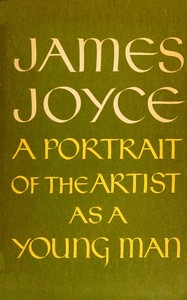
The catalog record for A Portrait of the Artist as a Young Man — Key Ideas to Explore provides practical reading context through 88,848 words, 6 hr 27 min estimated reading time, and 9 detected text sections.
The text analysis averages about 17.6 words per sentence, while the detected sections provide another way to judge how the source is divided.
Project Gutenberg metadata also associates the work with “Autobiographical fiction,” connecting these edition facts with the source record’s subject description.
Explore this collection
These alternatives are selected using recorded categories and estimated reading time.
About 392 minutes
Science Fiction Utopias
90,150 recorded words. 5 minutes difference from this book's estimate.
View Gutenberg source #1913About 371 minutes
Science Fiction Utopias
85,165 recorded words. 16 minutes difference from this book's estimate.
View Gutenberg source #3240About 403 minutes
Science Fiction Utopias
92,684 recorded words. 16 minutes difference from this book's estimate.
View Gutenberg source #3464Search stored excerpts and compare books → Choose by your preferences →
Choices use stored catalog measurements. Estimates vary with reading speed. A shared category is a catalog label, not a claim that two books have the same argument or literary quality.
Search reads excerpt text stored with this catalog and links to its associated Gutenberg record. The connection is stored in the site database; this tool does not recheck that every excerpt is word-for-word identical to that external record. Excerpt search does not cover every chapter and does not verify historical publication dates.
Catalog snapshot checked: 2026-09-25. Coverage: 93 public books, 93 available source excerpts.
Read the complete public-domain text at its original source.
Read on Project GutenbergThe novel begins with a story told to a child: "Once upon a time and a very good time it was there was a moocow coming down along the road." This nursery-rhyme cadence immediately establishes a world filtered through infant senses—songs, smells, and the threat of eagles pulling out eyes for not apologizing. The prose mimics a child's logic, with short, associative sentences and repetitive sounds. As Stephen grows, the language shifts: the playground is described with a more detached, observational tone, and later excerpts reveal a voice steeped in Catholic doctrine and aesthetic theory. Readers should attend to how Joyce alters sentence length, vocabulary, and rhythm to signal Stephen's changing mental states.
The opening pages immerse the reader in a pre-linguistic consciousness. Words are sounds first: "O, the green wothe botheth" captures a child's mispronunciation of a song. The narrative jumps between sensory impressions—the warmth of a wet bed, the queer smell of an oilsheet, the clapping of Uncle Charles and Dante. Objects are defined by their associations: Dante's brushes are for Michael Davitt and Parnell, political figures the child does not yet understand. The threat of punishment is rendered as a rhythmic chant: "Pull out his eyes, Apologise." This section establishes that the novel will not simply report events but render experience from within a limited, evolving perspective.
At Clongowes Wood School, Stephen navigates a world of boys and prefects. The football field is described with a simile—"the greasy leather orb flew like a heavy bird through the grey light"—that hints at an emerging literary sensibility. Stephen keeps to the fringe, "feigning to run now and then," aware of his small body and weak eyes. Social codes are learned through exchanges: Nasty Roche asks Stephen's name and his father's profession. Stephen's answer—"A gentleman"—is met with skepticism. The boys are judged by their gear: Rody Kickham has greaves and a hamper, while Nasty Roche has big hands and calls the pudding "dog-in-the-blanket." These details build a hierarchy based on possessions and nicknames.
A later excerpt presents a sermon on hell, delivered with relentless rhetorical force. The preacher piles up clauses: "ever to be eaten with flames, gnawed by vermin, goaded with burning spikes." The repetition of "ever, never" becomes a litany. The sermon argues that even a single venial sin—"a lie, an angry look, a moment of wilful sloth"—would demand infinite punishment from a just God. The language is visceral, invoking the crucifixion: "Every word of sin is a wound in His tender side." This section contrasts sharply with the earlier childlike prose, showing how institutional language can overwhelm individual consciousness. The reader witnesses Stephen absorbing this terrifying worldview, which will later provoke his rebellion.
Across the excerpts, Joyce employs distinct stylistic registers. The opening uses simple sentences and onomatopoeia ("Tralala lala"). The school scenes adopt a more conventional narrative voice but retain a child's limited understanding. The sermon is a block of rhythmic, hypnotic prose, almost incantatory. These shifts are not arbitrary; they reflect Stephen's development from sensory infant to socialized schoolboy to guilt-ridden adolescent. Readers should note how the narrator's distance from Stephen changes: sometimes the prose is inside his head, sometimes it observes him from outside. This technique, later called "free indirect discourse," allows the novel to trace the formation of an artistic identity without explicit commentary.
Because the excerpts cover only the first and third chapters, the novel's full arc—including Stephen's aesthetic awakening in Chapter IV and his departure in Chapter V—is not represented here. Readers should watch for further stylistic transformations, especially the diary-like entries at the end. The key to reading A Portrait is to treat each change in language as a clue to Stephen's inner life, rather than as a shift in the author's own voice.
That grey afternoon, Stephen’s fragmented childhood slipped into the rhythm of rain against the window, and I drifted from his stilted prayers into a quieter current. The same ache of growing—half-formed, hesitant—seemed to linger. Later, I found it again, gentler, in The Riverman — A Closer Reading, where water takes its time, much like memory does.
A brief reflection can help important ideas stay with you longer.