About 1,516 minutes
Little Dorrit — Reading Companion
Historical Social Novels
348,588 recorded words. 2 minutes difference from this book's estimate.
View Gutenberg source #963
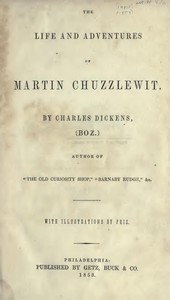
The source record for Martin Chuzzlewit — Background and Themes measures this digital text at 349,105 words, 25 hr 18 min estimated reading time, and 38 detected text sections.
The text analysis averages about 19.0 words per sentence, while the detected sections provide another way to judge how the source is divided.
Project Gutenberg metadata also associates the work with “Satire,” connecting these edition facts with the source record’s subject description.
Explore this collection
These alternatives are selected using recorded categories and estimated reading time.
About 1,516 minutes
Historical Social Novels
348,588 recorded words. 2 minutes difference from this book's estimate.
View Gutenberg source #963About 1,590 minutes
Historical Social Novels
365,486 recorded words. 72 minutes difference from this book's estimate.
View Gutenberg source #1023About 1,441 minutes
Historical Social Novels
331,205 recorded words. 77 minutes difference from this book's estimate.
View Gutenberg source #4397Search stored excerpts and compare books → Choose by your preferences →
Choices use stored catalog measurements. Estimates vary with reading speed. A shared category is a catalog label, not a claim that two books have the same argument or literary quality.
Search reads excerpt text stored with this catalog and links to its associated Gutenberg record. The connection is stored in the site database; this tool does not recheck that every excerpt is word-for-word identical to that external record. Excerpt search does not cover every chapter and does not verify historical publication dates.
Catalog snapshot checked: 2026-09-25. Coverage: 93 public books, 93 available source excerpts.
Read the complete public-domain text at its original source.
Read on Project GutenbergDickens structures Martin Chuzzlewit around a series of journeys—from England to America and back—that mirror the moral wanderings of its characters. The novel’s movement between scenes is punctuated by recurring images: fountains that sink, shadows that loom, and coffins that evoke death-in-life. In the preface, Dickens defends his portrayal of Jonas Chuzzlewit as “the legitimate issue of the father upon whom those vices are seen to recoil,” signaling a structural pattern of cause and effect that plays out across generations. The excerpts show how these motifs intensify in confined spaces, such as the sickroom where Mrs. Gamp tends a feverish patient, her shadow cast as “a gigantic night constable, struggling with a prisoner.”
The novel’s plot is propelled by physical movement: Martin Chuzzlewit’s voyage to America, his return, and the travels of other characters like young Martin and Mark Tapley. These journeys are not mere backdrop but structural devices that expose hypocrisy and test character. The American episodes, for instance, contrast sharply with the English settings, yet both are marked by greed and self-interest. Dickens uses the journey to create a rhythm of departure and return, each leg revealing new facets of avarice. The preface hints at this design, as Dickens argues that Jonas’s vices are “engendered” by his upbringing—a kind of moral journey from cause to effect. The reader is invited to trace how movement across geography parallels movement toward or away from integrity.
Three images recur with structural precision. The fountain appears in the sick man’s delirium: “Don’t you see how the fountain sinks?”—a metaphor for dwindling life or resources. Shadows dominate the sickroom scene, where Mrs. Gamp’s silhouette becomes “the shadow of a gigantic night constable.” This visual doubling suggests hidden threats and moral ambiguity. The coffin appears implicitly in the description of the silent city: “the dead of night was coffined in the silent city.” These images are not decorative; they form a network that links physical decay to spiritual emptiness. Dickens weaves them into scenes of confinement—the sickroom, the night—to reinforce the novel’s critique of a society that buries its conscience.
The extended excerpt from a sickroom scene demonstrates how Dickens concentrates his themes in a single, claustrophobic setting. The patient’s feverish counting and hallucinations (“five hundred and twenty-one men, all dressed alike”) evoke a world of mechanical repetition and dehumanization. Mrs. Gamp, the nurse, responds with mundane practicality—lighting a fire, making tea—while her shadow plays out a grotesque pantomime. The room becomes a stage where the struggle between life and death, sanity and madness, is enacted. Dickens’s prose shifts between the patient’s fragmented speech and Mrs. Gamp’s colloquial interjections, creating a rhythm of tension and bathos. This scene encapsulates the novel’s method: using confined spaces to magnify moral and psychological states.
Dickens differentiates characters through distinct speech patterns that also serve structural functions. Mrs. Gamp’s dialogue is peppered with proverbs and misquotations (“One, two, buckle my shoe”), which contrast with the patient’s urgent, fragmented cries. This juxtaposition creates a counterpoint between the mundane and the desperate. In the preface, Dickens’s own voice is defensive and analytical, directly addressing the reader about “exaggeration” and “poetical justice.” These vocal shifts—from authorial commentary to character idiolect—mark transitions between narrative levels. The novel’s structure relies on such shifts to move between satire, pathos, and social critique, often within the same chapter.
Readers attentive to the novel’s structure will notice how Dickens repeats and varies key images across different settings, creating a web of connections that reward close reading. The journey motif, the sickroom microcosm, and the interplay of voices all contribute to a work that is as much about the architecture of greed as about individual characters. Pay particular attention to how scenes of confinement—rooms, coaches, ships—function as pressure chambers for the novel’s moral concerns.
Reading Martin Chuzzlewit again, I kept noticing how Dickens’s fountains run dry right where the coffins wait—greed quietly snuffing out light. That shadowy rhythm reminded me of something quieter in Beyond — A Reader’s Guide, which traces similar returns home without quite saying so. It felt less like analysis, more like a long walk back.
Capture what you thought, learned, and would like to remember.