About 314 minutes
The Intrusion of Jimmy — Inside the Classic
Historical Social Novels
72,131 recorded words. 2 minutes difference from this book's estimate.
View Gutenberg source #4075
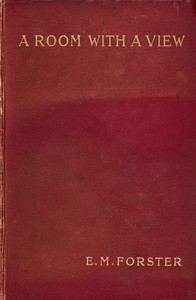
The catalog record for A Room with a View — Inside the Classic provides practical reading context through 71,759 words, 5 hr 12 min estimated reading time, and 22 detected text sections.
The text analysis averages about 12.2 words per sentence, while the detected sections provide another way to judge how the source is divided.
Project Gutenberg metadata also associates the work with “Humorous stories,” connecting these edition facts with the source record’s subject description.
Explore this collection
These alternatives are selected using recorded categories and estimated reading time.
About 314 minutes
Historical Social Novels
72,131 recorded words. 2 minutes difference from this book's estimate.
View Gutenberg source #4075About 284 minutes
Historical Social Novels
65,137 recorded words. 28 minutes difference from this book's estimate.
View Gutenberg source #3430About 348 minutes
Historical Social Novels
79,862 recorded words. 36 minutes difference from this book's estimate.
View Gutenberg source #1214Search stored excerpts and compare books → Choose by your preferences →
Choices use stored catalog measurements. Estimates vary with reading speed. A shared category is a catalog label, not a claim that two books have the same argument or literary quality.
Search reads excerpt text stored with this catalog and links to its associated Gutenberg record. The connection is stored in the site database; this tool does not recheck that every excerpt is word-for-word identical to that external record. Excerpt search does not cover every chapter and does not verify historical publication dates.
Catalog snapshot checked: 2026-09-25. Coverage: 93 public books, 93 available source excerpts.
Read the complete public-domain text at its original source.
Read on Project GutenbergThe novel opens with a dispute over a room. Miss Bartlett and Lucy Honeychurch, newly arrived at the Pension Bertolini in Florence, have been promised south-facing rooms with a view of the Arno but instead are given north-facing rooms looking into a courtyard. This initial wrangle over a view establishes a pattern of spatial confinement and longed-for openness that runs through the entire work. Forster repeatedly places his characters in enclosed spaces—pensions, drawing rooms, a tennis court—and then moves them to open landscapes, churches, or hillsides. The structure of the book, divided into two parts titled “Part One” and “Part Two,” mirrors this binary: Italy versus England, constraint versus release.
The phrase “a room with a view” is not merely a title but a structural device. In the opening chapter, the view is something promised but denied. Later, when the Emersons offer to exchange rooms, the view becomes a token of generosity and a breach of social form. Forster returns to the motif in Part Two, where Lucy’s home in Surrey is described as a “circle of rich, pleasant people” from which she feels increasingly detached. The view in Italy was literal—a window onto the Arno—but in England it becomes metaphorical: Lucy’s “new eyes” see the narrowness of her society. The novel’s movement between these two kinds of viewing—physical and psychological—gives the structure a clear arc.
Forster fills the novel with images of bounded spaces: the pension dining room with its “two rows of English people,” the framed portraits of the Queen and Poet Laureate, the notice of the English church on the wall. These details create a sense of being hemmed in by Englishness abroad. In contrast, the Italian scenes offer sudden openings: the view from the hill, the olive-yard where “you jump over” social barriers, the Piazza Signoria where Lucy witnesses a murder. The tennis court in Part Two, where Lucy plays “bumble-puppy,” is another enclosed space, but one where she can move freely. The recurrence of these images—walls, windows, doors, horizons—gives the novel a visual rhythm that reinforces its thematic concerns.
The novel’s structure is built on a series of journeys: from the pension to Santa Croce, from Florence to the hills, from Italy back to England, and then from Surrey to London and back. Each movement is accompanied by a shift in social register. In the pension, the characters are bound by the rules of Englishness abroad; in the carriage drive, they are thrown together in a way that loosens those rules. Forster uses the journey itself as a device to rearrange his characters, forcing them into proximity and conflict. The chapter titles often announce these movements explicitly, as in the long title of Chapter VI, which lists all the characters who “drive out in carriages to see a view.” This methodical listing underscores the choreographed nature of the social world.
Forster pays close attention to the physical objects that surround his characters: the “white bottles of water and red bottles of wine” on the pension table, the “portraits of the late Queen and the late Poet Laureate,” the “notice of the English church.” These details are not mere decoration; they anchor the characters in a specific material world and often carry symbolic weight. The “Saturn” tennis ball with its “unsewn” skin, described in the bumble-puppy scene, is a small comic detail that also hints at imperfection and decay. The “boiler” in the chapter title “How Miss Bartlett’s Boiler Was So Tiresome” is another such object—mundane yet disruptive. By weaving these objects into the narrative, Forster creates a texture that feels both precise and resonant.
Readers attentive to Forster’s use of space and movement will find that the novel’s structure rewards close attention to where scenes are set and how characters pass from one place to another. The recurring images of windows, views, and enclosures are not merely atmospheric but form a coherent pattern that deepens the story’s central conflict. Watching how Lucy navigates these spaces—and how the novel’s settings shift around her—offers a way into the book that goes beyond plot alone.
I remember sitting by a window myself, half-listening to distant chatter, feeling that strange pull between staying safe and stepping out. Forster’s rooms and piazzas remind me of that. Then I found the same hesitant, comic ache in Love Among the Chickens — Key Ideas to Explore, where ordinary chaos quietly opens a door. It felt like a familiar afternoon, unhurried, gently asking nothing of me.
A brief reflection can help important ideas stay with you longer.