About 1,441 minutes
The Forsyte saga - Complete — Edition Insights
Historical Social Novels
331,205 recorded words. 102 minutes difference from this book's estimate.
View Gutenberg source #4397
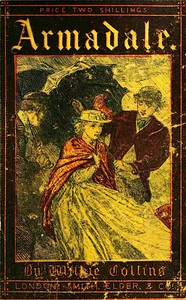
Armadale — Edition Insights can be approached with a clearer sense of reading commitment from its source measurements: 307,849 words, 22 hr 19 min estimated reading time, and 29 detected text sections.
The text analysis averages about 17.3 words per sentence, while the detected sections provide another way to judge how the source is divided.
Project Gutenberg metadata also associates the work with “England -- Social life and customs -- 19th century -- Fiction,” connecting these edition facts with the source record’s subject description.
Explore this collection
These alternatives are selected using recorded categories and estimated reading time.
About 1,441 minutes
Historical Social Novels
331,205 recorded words. 102 minutes difference from this book's estimate.
View Gutenberg source #4397About 1,516 minutes
Historical Social Novels
348,588 recorded words. 177 minutes difference from this book's estimate.
View Gutenberg source #963About 1,518 minutes
Historical Social Novels
349,105 recorded words. 179 minutes difference from this book's estimate.
View Gutenberg source #968Search stored excerpts and compare books → Choose by your preferences →
Choices use stored catalog measurements. Estimates vary with reading speed. A shared category is a catalog label, not a claim that two books have the same argument or literary quality.
Search reads excerpt text stored with this catalog and links to its associated Gutenberg record. The connection is stored in the site database; this tool does not recheck that every excerpt is word-for-word identical to that external record. Excerpt search does not cover every chapter and does not verify historical publication dates.
Catalog snapshot checked: 2026-09-25. Coverage: 93 public books, 93 available source excerpts.
Read the complete public-domain text at its original source.
Read on Project GutenbergFrom its first sentence, Armadale announces a world of waiting and expectation: “It was the opening of the season of eighteen hundred and thirty-two, at the Baths of Wildbad.” The novel’s prologue, set in a German spa, introduces two travelers whose encounter will reverberate across the story. Collins builds suspense through meticulous description of setting and gesture, a technique he sustains across the book’s many chapters. The narrative voice shifts between omniscient commentary and close third-person focalization, often lingering on characters’ internal doubts. In the excerpted dialogue between Allan Armadale and his lawyer Pedgift Junior, Collins reveals information through careful, halting exchanges: Pedgift “winding his way a little deeper into the secret” while Allan proves “a bad hand at defending myself against a sharp fellow like you.” Such verbal sparring drives the plot forward without relying on overt action.
Collins crafts conversations that advance the mystery while withholding full disclosure. In the exchange with Pedgift Junior, Allan’s reluctance to name the “other person” involved in the inquiry creates tension. Pedgift’s questions are phrased as cautious probes: “Do you mind telling me whether others besides yourself are interested in this inquiry of ours?” The lawyer’s professional manner “began to show itself again from sheer force of habit,” signaling that even his directness is a performance. Allan’s responses are marked by evasion and self-deprecation, as when he admits he is “a bad hand at defending myself.” The dialogue thus becomes a chess game of revelation and concealment, with each character guarding their knowledge. Collins uses this technique to keep the reader aware that crucial information is being parceled out slowly, often through implication rather than statement.
The word “reference” recurs in the excerpt as a loaded term. Pedgift Junior speaks of “the difficulty of approaching Miss Gwilt’s reference,” and later the narrative notes that the cabman’s evidence connected “Miss Gwilt’s reference with the house in Pimlico.” Collins invests this bureaucratic term with immense narrative weight: a forged character reference becomes the linchpin of the plot. The novel’s legal and social world treats such documents as guarantees of respectability, yet the story systematically undermines that trust. Allan’s shock upon hearing the truth is described in somatic terms: “Allan suffered the shock, as all great shocks are suffered, in silence.” The reference, a piece of paper, stands in for a hidden life. Collins’s choice to foreground this detail reflects his interest in the gap between public reputation and private reality, a theme he develops through the novel’s intricate plotting.
The table of contents reveals a deliberate fragmentation: the story is divided into a prologue, four books, and an epilogue, with several sections titled “Miss Gwilt’s Diary.” This use of diary entries as a narrative device allows Collins to present events from a subjective, emotionally charged perspective. The diary sections break the chronological flow and offer direct access to a character’s thoughts, contrasting with the third-person narration elsewhere. In the excerpt, the narrator describes how “doubts troubled him which he could neither understand nor express,” a formulation that echoes the diary’s introspective mode. The novel’s structure thus mirrors its thematic concern with hidden knowledge: the reader must piece together truth from multiple, sometimes conflicting, accounts. Collins’s prefatory note warns that the book “oversteps, in more than one direction, the narrow limits” of conventional fiction, and the fragmented structure is one such boundary-crossing.
Collins uses setting to reflect characters’ inner states. The prologue opens at the Baths of Wildbad, a liminal space where travelers pause before their fates intersect. Later, the Norfolk Broads and the house in Pimlico become sites of danger and concealment. In the excerpt, the lawyer’s office is a space of professional formality that gives way to whispered secrets. The narrative notes that Pedgift “drew his chair, in his turn, nearer to Allan,” physically closing the distance as the conversation grows more intimate and threatening. The cabman’s evidence about the house in Pimlico is described as “irrevocable words,” and the setting of that house—a place of “criminal concealment”—haunts the dialogue. Collins rarely describes a location without linking it to a character’s emotional state; the Wildbad evening shadows, for instance, foreshadow the darkness that will envelop the protagonists.
Readers approaching Armadale should attend to the interplay between what characters say and what they withhold. Collins’s prose rewards careful attention to legalistic phrasing, diary entries, and the physical details of setting. The novel’s length—over 300,000 words—allows for a slow accumulation of clues and misdirections. Rather than expecting a straightforward narrative, prepare for a story that unfolds through fragments, letters, and confessions. The author’s own preface warns that the book may disturb readers who prefer fiction to stay within conventional bounds; that disturbance is part of its design.
There’s something about the way Collins lets Miss Gwilt’s motives stay half-hidden, locked inside her own testimony, that lingers. It made me think of Isabel Archer, how her freedom becomes its own quiet trap. I keep returning to that feeling—of a life shaped by what’s left unsaid, in Armadale and again in The Portrait of a Lady — Volume 1 — Themes and Context.
Answer a few questions and save a private reflection on this device.