About 573 minutes
The U. P. Trail — Reading Notes
Historical Social Novels
131,748 recorded words. 1 minutes difference from this book's estimate.
View Gutenberg source #4684
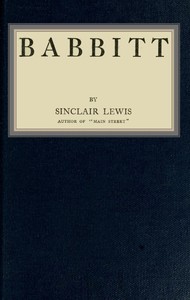
Babbitt — Text and Context can be approached with a clearer sense of reading commitment from its source measurements: 131,967 words, 9 hr 34 min estimated reading time, and 13 detected text sections.
The text analysis averages about 17.2 words per sentence, while the detected sections provide another way to judge how the source is divided.
Project Gutenberg metadata also associates the work with “Satire,” connecting these edition facts with the source record’s subject description.
Explore this collection
These alternatives are selected using recorded categories and estimated reading time.
About 573 minutes
Historical Social Novels
131,748 recorded words. 1 minutes difference from this book's estimate.
View Gutenberg source #4684About 564 minutes
Historical Social Novels
129,496 recorded words. 10 minutes difference from this book's estimate.
View Gutenberg source #4382About 598 minutes
Historical Social Novels
137,316 recorded words. 24 minutes difference from this book's estimate.
View Gutenberg source #904Search stored excerpts and compare books → Choose by your preferences →
Choices use stored catalog measurements. Estimates vary with reading speed. A shared category is a catalog label, not a claim that two books have the same argument or literary quality.
Search reads excerpt text stored with this catalog and links to its associated Gutenberg record. The connection is stored in the site database; this tool does not recheck that every excerpt is word-for-word identical to that external record. Excerpt search does not cover every chapter and does not verify historical publication dates.
Catalog snapshot checked: 2026-09-25. Coverage: 93 public books, 93 available source excerpts.
Read the complete public-domain text at its original source.
Read on Project GutenbergThe opening of Babbitt presents a striking contrast between the city of Zenith—its towers 'frankly and beautifully office-buildings'—and the man who will inhabit its domestic spaces. The prose initially soars with a panoramic view of steel, cement, and limestone, then narrows to a sleeping-porch where George F. Babbitt lies 'exceedingly well fed,' his hand 'slightly puffy.' This descent from the monumental to the mundane is the novel's first structural move. The catalog subjects list 'Satire' and 'Conformity,' and the excerpts indeed show a protagonist whose thoughts are shaped by social performance: he frets over the McKelveys' laughter and endures a dinner with the failing Ed Overbrook, all while maintaining a facade of joviality. Yet the psychological fiction tag is less evident in these passages, which focus on external behavior rather than interior conflict.
The novel begins not with Babbitt but with Zenith itself. The description of 'austere towers of steel and cement and limestone' and 'clean towers' thrusting out 'grotesqueries' establishes a setting that is both modern and aspirational. The prose is deliberately lyrical: 'The mist took pity on the fretted structures of earlier generations.' This elevated tone is undercut immediately by the introduction of Babbitt, whose awakening is described in terms of physical ordinariness—'his face was babyish in slumber, despite his wrinkles and the red spectacle-dents.' The juxtaposition suggests that the city's grandeur is at odds with its inhabitants' mundane lives. The catalog subject 'Satire' operates here through this incongruity: the novel's voice can shift from the poetic to the deflating within a single paragraph, a technique that mocks both the city's pretensions and the protagonist's lack of grandeur.
Babbitt's interactions reveal a man constantly managing appearances. When he attends the Overbrooks' dinner, he plans to 'duck out quick' and invents an early office meeting. His internal monologue is a mix of condescension and unease: he finds the house 'depressing' and the other guests 'dreadful,' yet he is 'touched' by Overbrook's praise. The excerpts show him 'oppressed by futility' after a social slight, and he betrays his depression by 'the violence with which he informed his wife' about the McKelveys. These moments align with the catalog subject 'Conformity'—Babbitt adheres to social codes (accepting the dinner invitation, performing cordiality) but chafes against them. The satire is evident in the gap between his public bonhomie and private irritation. Notably, the excerpts do not show Babbitt reflecting on his own motives; his anxiety is expressed through action and dialogue, not introspection.
The catalog lists 'Businessmen -- Fiction' and 'Middle-aged men -- Fiction,' and the excerpts offer a specific view of Babbitt's professional life. He is 'nimble in the calling of selling houses for more than people could afford to pay'—a definition that frames his work as ethically dubious. Yet the excerpts focus less on business transactions than on its social fallout. Ed Overbrook, a failed insurance salesman, is described as 'gray and thin and unimportant,' a contrast to Babbitt's prosperity. Babbitt's response to Overbrook's admiration is a mix of pleasure and 'a sense of responsibility,' but he ultimately finds the man's company a burden. The novel's satire of business culture emerges through these relationships: success is measured by appearances, and failure is pitied but avoided. The excerpts do not depict Babbitt's actual work—no deals, no clients—only the social obligations it generates, suggesting that the novel's critique is more about the performance of business than its substance.
Readers approaching Babbitt should attend to the novel's tonal shifts: the opening's lyrical cityscape gives way to a protagonist whose inner life is largely expressed through social anxiety and physical description. The excerpts offer a limited view of Babbitt's psychology, focusing instead on his reactions to others. The catalog subjects of satire and conformity are well-supported, but the 'Psychological fiction' tag may require reading beyond these passages to assess. The novel's critique of middle-class life is embedded in its details—the 'khaki-colored blanket,' the 'shiny blue serge business-suit'—and rewards close attention to what is said and what is left unsaid.
Reading about Babbitt’s restless domestic anxieties, I kept thinking how rarely we see that quiet ache in old stories. It made me remember another book, one that stayed with me long after—Ramona — Reading Companion—for how gently it lets a character sit with life’s unanswered questions. Something about that lingering feeling feels familiar, like a room we’ve both known.
Use these questions to collect your thoughts before moving on.