About 544 minutes
The Portrait of a Lady — Volume 1 — Themes and Context
Historical Social Novels
124,959 recorded words. 0 minutes difference from this book's estimate.
View Gutenberg source #2833
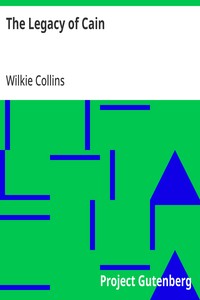
Before opening The Legacy of Cain — Text and Context, the edition data offers a quick orientation: 124,913 words, 9 hr 4 min estimated reading time, and 16 detected text sections.
The text analysis averages about 14.1 words per sentence, while the detected sections provide another way to judge how the source is divided.
Project Gutenberg metadata also associates the work with “England -- Fiction,” connecting these edition facts with the source record’s subject description.
Explore this collection
These alternatives are selected using recorded categories and estimated reading time.
About 544 minutes
Historical Social Novels
124,959 recorded words. 0 minutes difference from this book's estimate.
View Gutenberg source #2833About 528 minutes
Historical Social Novels
121,407 recorded words. 16 minutes difference from this book's estimate.
View Gutenberg source #2834About 526 minutes
Historical Social Novels
120,948 recorded words. 18 minutes difference from this book's estimate.
View Gutenberg source #2453Search stored excerpts and compare books → Choose by your preferences →
Choices use stored catalog measurements. Estimates vary with reading speed. A shared category is a catalog label, not a claim that two books have the same argument or literary quality.
Search reads excerpt text stored with this catalog and links to its associated Gutenberg record. The connection is stored in the site database; this tool does not recheck that every excerpt is word-for-word identical to that external record. Excerpt search does not cover every chapter and does not verify historical publication dates.
Catalog snapshot checked: 2026-09-25. Coverage: 93 public books, 93 available source excerpts.
Read the complete public-domain text at its original source.
Read on Project GutenbergThe novel opens not with a crime but with its aftermath: a prison governor recounts events from 1858-1859, framing the story through institutional records. Collins immediately establishes a layered narrative structure, shifting from the governor's official account to the private diaries of two sisters, Helena and Eunice, in 1875. This structural choice creates a tension between public documentation and intimate confession, inviting readers to weigh competing perspectives.
The excerpts reveal a preoccupation with hidden knowledge and delayed revelation. Characters speak at cross-purposes, as when Miss Jillgall assumes the governor knows Philip Dunboyne's name, only to discover he is ignorant of the family's past. Such moments of miscommunication underscore the novel's central concern: how secrets shape relationships across generations.
The first period is narrated by the prison governor, who describes events within the prison walls. His voice is measured and official, yet he admits to being “petrified” by a sudden disclosure. The governor's account establishes the moral weight of the minister's decision to adopt a child of a condemned murderess. Collins uses the governor's limited knowledge to create suspense: the reader knows only what he chooses to reveal. The chapter titles—such as “The Murderess Asks Questions” and “The Minister Says Yes”—hint at pivotal conversations that are not fully reproduced in the excerpts, leaving gaps that the diaries may later fill.
The second period shifts to the diaries of Helena and Eunice, the two adopted sisters. The excerpts show Helena's diary entries outnumbering Eunice's, suggesting a dominant voice. Yet the chapter titles—such as “The Shameless Sister” and “The Adopted Child”—imply moral judgment and asymmetry. Collins uses the diary form to present subjective truths: Helena's entries may be self-serving, while Eunice's may be more vulnerable. The reader must navigate these competing accounts, much like the governor must piece together events from incomplete information. The diaries also introduce Philip Dunboyne, whose name triggers a crisis of recognition in the governor.
Throughout the excerpts, characters grapple with knowledge that is only partially shared. The minister, Mr. Gracedieu, is said to have been burdened by “the terrible choice of responsibilities” foreseen by the governor. Miss Jillgall, a minor character, provides comic relief with her “quaint curtsey” and self-deprecating humor, yet she also carries crucial information about Philip's identity. The novel's structure—moving from prison to domestic life—mirrors the way past crimes infiltrate present relationships. Collins withholds key facts, such as the exact nature of the “legacy of Cain,” forcing readers to infer from oblique references and emotional reactions.
Readers should attend to the gaps between what characters say and what they know. The diary entries, in particular, reward careful comparison: Helena's confidence may mask insecurity, while Eunice's reticence may conceal strength. The novel's power lies not in dramatic revelations but in the slow accumulation of misunderstandings and half-truths. Approach the text as a puzzle of perspectives, where each narrator offers a piece of a story that no single character fully possesses.
That rainy afternoon, The Legacy of Cain left me restless—all those shifting voices around Helena and Eunice, each hiding something true. I set it down, and my gaze drifted to another spine, almost apologetically. Its quiet presence felt like a hand on my shoulder, whispering that secrets also live in other houses. Clotelle: A Tale of the Southern States — A Reader’s Guide waited there, patient as the rain.
Save your reaction, strongest insight, and memorable passage.