About 406 minutes
Beautiful Joe: An Autobiography — A Closer Reading
Historical Social Novels
93,318 recorded words. 5 minutes difference from this book's estimate.
View Gutenberg source #2818
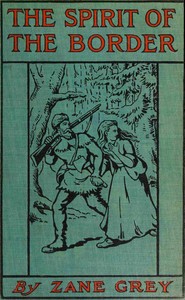
The catalog record for The Spirit of the Border: A Romance of the Early Settlers in the Ohio Valley — Edition Insights provides practical reading context through 92,071 words, 6 hr 41 min estimated reading time, and 9 detected text sections.
The text analysis averages about 14.0 words per sentence, while the detected sections provide another way to judge how the source is divided.
Project Gutenberg metadata also associates the work with “Historical fiction,” connecting these edition facts with the source record’s subject description.
Explore this collection
These alternatives are selected using recorded categories and estimated reading time.
About 406 minutes
Historical Social Novels
93,318 recorded words. 5 minutes difference from this book's estimate.
View Gutenberg source #2818About 406 minutes
Historical Social Novels
93,292 recorded words. 5 minutes difference from this book's estimate.
View Gutenberg source #3817About 411 minutes
Historical Social Novels
94,444 recorded words. 10 minutes difference from this book's estimate.
View Gutenberg source #1098Search stored excerpts and compare books → Choose by your preferences →
Choices use stored catalog measurements. Estimates vary with reading speed. A shared category is a catalog label, not a claim that two books have the same argument or literary quality.
Search reads excerpt text stored with this catalog and links to its associated Gutenberg record. The connection is stored in the site database; this tool does not recheck that every excerpt is word-for-word identical to that external record. Excerpt search does not cover every chapter and does not verify historical publication dates.
Catalog snapshot checked: 2026-09-25. Coverage: 93 public books, 93 available source excerpts.
Read the complete public-domain text at its original source.
Read on Project GutenbergZane Grey's The Spirit of the Border opens with an author's note that frames the novel as a corrective to historical neglect. Grey claims access to the lost journal of Colonel Ebenezer Zane and insists that the story's 'wild spirit' is true to the Western border of the late eighteenth century. The excerpts, however, offer little direct evidence of that journal's content. Instead, they present a sustained scene of physical pursuit: a boy named Joe struggles to keep pace with the hunter Wetzel during a five-mile run across a plain, his exhaustion rendered in visceral detail—'a sharp pain seized upon his side; a blood-red film obscured his sight.' The narrative voice shifts between Joe's limited perspective and Wetzel's terse, dialect-heavy commands, a technique that emphasizes the gap between the novice and the seasoned frontiersman.
The excerpted pursuit sequence hinges on a method of tracking that relies on minute environmental cues. When Wetzel and Joe reach a forked stream, Wetzel instructs Joe to observe fish behavior to determine which branch the Indians took. The instructions are precise: 'crawl close to the bank so you can jest peep over. Be keerful not to show the tip of your head, an' don't knock nothin' off'en the bank into the water.' Joe then scrutinizes a pool, noting the absence of crawfish, turtles, and frogs before spotting a trout. The logic—that trout indicate cooler, spring-fed water where a canoe might be hidden—is never stated outright, but emerges through the characters' actions. This passage demonstrates Grey's interest in the practical knowledge of the wilderness, a theme that the catalog subject 'Scouting (Reconnaissance) — Fiction' captures accurately, though the excerpts show it as a skill demonstrated rather than explained.
Grey's prose in the excerpts emphasizes the physical toll of frontier life. Joe's run across the plain is described in terms of bodily limits: his head feels 'about to burst,' his side aches, and his sight blurs. When he collapses, the narrative notes that he recovers his breath and gets up, but the episode underscores the disparity between his endurance and Wetzel's, whose only sign of exertion is a slightly faster rise and fall of his chest. The landscape itself is rendered with careful specificity—'a grove of beeches,' 'a swift stream,' 'a rocky head of what appeared to be a wooded island'—but it is never romanticized. Instead, it functions as an obstacle to be read and overcome. This focus on physical struggle aligns with the catalog subject 'Frontier and pioneer life — Fiction,' though the excerpts offer no domestic scenes; the frontier here is a space of constant motion and vigilance.
Wetzel's speech in the excerpts is marked by colloquial contractions and nonstandard grammar: 'Mebbe we can't; but we'll try,' 'Grab up a few of them bugs,' 'Be keerful.' This dialect serves to distinguish him from Joe, whose narration is more standard, and to root the character in a specific regional and social context. Grey's authorial note claims the story will 'paint the fever of freedom' and 'not forget the wronged Indian,' but the excerpts show no Native American characters directly; Indians are present only as a threat, inferred from a hidden canoe and the direction of travel. The catalog subject 'Indians of North America — Wars — 1750-1815 — Fiction' is thus represented obliquely. The gap between Grey's stated intentions and the excerpts' focus on white characters' physical ordeal suggests that the novel's treatment of Indigenous peoples may be mediated through the settlers' perspective, a limitation the reader should keep in mind.
Readers approaching The Spirit of the Border should note that the excerpts represent only a small portion of a long novel. The catalog subjects promise historical fiction involving Betty Zane and Lewis Wetzel, but the provided text focuses on a single tracking episode. Grey's introduction claims a basis in a lost journal, yet the excerpts do not verify this. The novel's value may lie less in historical accuracy than in its detailed depiction of wilderness skills and physical endurance. Pay attention to how Grey balances his stated sympathy for Native Americans with the narrative's reliance on Indian threat as a plot engine.
I kept thinking about how that old Zane Grey story makes you feel every step of the trail, the quiet weight of the woods pressing in. It stayed with me like a half-remembered conversation. Something in Clarence — Reading Notes felt similar, that same patient way of sitting with a character’s inner distance. A friend mentioned it once, softly, as if it were a secret. I understood. Clarence — Reading Notes lingers the same way.
A brief reflection can help important ideas stay with you longer.