About 201 minutes
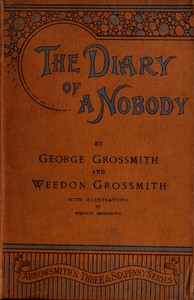
The Diary of a Nobody — Text and Context
Historical Social Novels
46,044 recorded words. 16 minutes difference from this book's estimate.
View Gutenberg source #1026
Before opening The Woman Who Did — Context and Discussion, the edition data offers a quick orientation: 49,772 words, 3 hr 37 min estimated reading time, and 5 detected text sections.
The text analysis averages about 18.5 words per sentence, while the detected sections provide another way to judge how the source is divided.
Project Gutenberg metadata also associates the work with “England -- Fiction,” connecting these edition facts with the source record’s subject description.
Explore this collection
These alternatives are selected using recorded categories and estimated reading time.
About 201 minutes
Historical Social Novels
46,044 recorded words. 16 minutes difference from this book's estimate.
View Gutenberg source #1026About 236 minutes
Historical Social Novels
54,235 recorded words. 19 minutes difference from this book's estimate.
View Gutenberg source #3829About 237 minutes
Historical Social Novels
54,415 recorded words. 20 minutes difference from this book's estimate.
View Gutenberg source #1905Search stored excerpts and compare books → Choose by your preferences →
Choices use stored catalog measurements. Estimates vary with reading speed. A shared category is a catalog label, not a claim that two books have the same argument or literary quality.
Search reads excerpt text stored with this catalog and links to its associated Gutenberg record. The connection is stored in the site database; this tool does not recheck that every excerpt is word-for-word identical to that external record. Excerpt search does not cover every chapter and does not verify historical publication dates.
Catalog snapshot checked: 2026-09-25. Coverage: 93 public books, 93 available source excerpts.
Read the complete public-domain text at its original source.
Read on Project GutenbergGrant Allen opens The Woman Who Did with a landscape description that does more than set a scene. The lawn at Mrs. Dewsbury’s is composed of “a tiny yellow clover” that gives “beneath the foot like the pile on velvet.” This tactile detail, combined with the “misty haze that broods eternally over the wooded valley,” establishes a distinctly English atmosphere, contrasted explicitly with the “sharp and clear-cut Italian outlines” Alan Merrick has just left. The dialogue that follows is equally precise: Alan’s distaste for deans is met with Mrs. Dewsbury’s “recondite and diplomatic” smile and her retort that Herminia “doesn’t either.” This exchange, in under fifty words, sketches character and conflict without exposition.
Allen’s word choices reveal his characters’ inner lives through small, telling verbs and adjectives. When Alan is introduced to Herminia, he “drew back with a vague gesture of distaste”—the word “vague” suggesting a reflexive, almost unconscious aversion. Later, Herminia’s reaction to Perugia is rendered through verbs of negation: the hills “depressed her,” the Etruscan tombs “stirred her heart but feebly,” and St. Francis “fell flat on her English fancy.” These are not grand pronouncements but quiet, cumulative rejections. The narrator’s vocabulary for Alan’s sketching—he “revelled all day long in his native element”—contrasts sharply with Herminia’s passive “wondered how he could sit so long.” Such lexical choices build a portrait of two people fundamentally out of sync, long before the crisis arrives.
The dialogue in the opening pages is economical but loaded. Mrs. Dewsbury’s “gay wisdom” in pairing Alan with Herminia because she also dislikes deans is a light, almost comic moment, yet it foreshadows deeper ideological divides. When Alan later falls ill, the telegram from his father—“marry the girl at once, and legitimatise your child”—introduces a blunt, legalistic voice that clashes with the couple’s professed principles. Herminia’s internal response is rendered in indirect speech: “she feared lest in this extremity… he might wish to take his father’s advice, and prove untrue to their common principles.” The word “common” here is telling, implying a shared creed that is now under threat. Allen uses dialogue and its reported aftermath to dramatize the conflict between personal conviction and social pressure.
The description of the Surrey landscape in the opening paragraph is not merely decorative. The “endless middle distances” and “uncertain blue line” of the South Downs mirror the moral and emotional ambiguities to come. When the scene shifts to Perugia, the setting becomes actively hostile: “Bare white boughs of twisted fig-trees depressed her.” The adjectives “bare,” “twisted,” and “depressed” are chosen to reflect Herminia’s growing unease. The Italian doctor’s diagnosis of typhoid is delivered with clinical precision—“Twenty-one days before… he had drunk a single glass of water”—and the narrative then shifts to a scientific register: “those victorious microbes had brooded in silence in his poisoned arteries.” This juxtaposition of the picturesque with the pathological underscores the novel’s concern with hidden dangers and the fragility of idealistic plans.
Allen repeatedly draws attention to the act of seeing and representing. Alan is introduced as a painter “diverted by pure circumstance into a Chancery practice,” and his sketching in Perugia is described in detail: “He sketched every morning, among the huddled, strangled lanes; sketched churches and monasteries, and portals of palazzi.” The repetition of “sketched” emphasizes his compulsion to frame and fix the world. Herminia, by contrast, fails to respond to art: “The very pictures in the gallery failed to interest Herminia, she knew not why.” This recurring motif—one character who sees through an artist’s lens, another who remains unmoved—is a subtle structural device. It suggests that their incompatibility is not merely ideological but perceptual, rooted in how each engages with the world.
Readers approaching The Woman Who Did should attend to the precision of Allen’s language, particularly in the early chapters where character is established through small gestures and offhand remarks. The novel’s arguments about marriage, motherhood, and independence are carried not by abstract debate but by concrete scenes—a lawn, a telegram, a fever. The excerpts offer a limited view, but they reveal a writer who trusts his details to do the work of persuasion.
There’s a particular ache in rereading Allen’s descriptions of the typhoid fever in Perugia—how he lingers on details that feel almost accidental, the way memory itself surprises us. It reminded me, quietly, of the gentler notes I found in Clarence — Reading Notes, where the same patient eye turns toward what remains unspoken. I still think about that opening scene sometimes, on ordinary afternoons.
Use these questions to collect your thoughts before moving on.