About 401 minutes
The Spirit of the Border: A Romance of the Early Settlers in the Ohio Valley — Edition Insights
Historical Social Novels
92,071 recorded words. 11 minutes difference from this book's estimate.
View Gutenberg source #1239
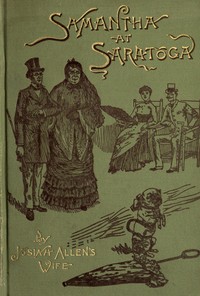
This digital edition of Samantha at Saratoga — A Closer Reading is described by source-level measurements including 89,689 words, 6 hr 30 min estimated reading time, and 22 detected text sections.
The text analysis averages about 21.1 words per sentence, while the detected sections provide another way to judge how the source is divided.
Project Gutenberg metadata also associates the work with “Rich people -- Fiction,” connecting these edition facts with the source record’s subject description.
Explore this collection
These alternatives are selected using recorded categories and estimated reading time.
About 401 minutes
Historical Social Novels
92,071 recorded words. 11 minutes difference from this book's estimate.
View Gutenberg source #1239About 375 minutes
Historical Social Novels
86,045 recorded words. 15 minutes difference from this book's estimate.
View Gutenberg source #1845About 406 minutes
Historical Social Novels
93,318 recorded words. 16 minutes difference from this book's estimate.
View Gutenberg source #2818Search stored excerpts and compare books → Choose by your preferences →
Choices use stored catalog measurements. Estimates vary with reading speed. A shared category is a catalog label, not a claim that two books have the same argument or literary quality.
Search reads excerpt text stored with this catalog and links to its associated Gutenberg record. The connection is stored in the site database; this tool does not recheck that every excerpt is word-for-word identical to that external record. Excerpt search does not cover every chapter and does not verify historical publication dates.
Catalog snapshot checked: 2026-09-25. Coverage: 93 public books, 93 available source excerpts.
Read the complete public-domain text at its original source.
Read on Project GutenbergMarietta Holley’s Samantha at Saratoga opens with a dedication that immediately establishes the narrator’s voice: Samantha, wife of Josiah Allen, speaks in a rustic dialect full of homely metaphors and wry asides. The preface, which she calls “A Sort of Preface. Which It Is Not Necessary to Read,” sets the tone for a work that uses colloquial speech to critique social climbing and the restless pursuit of pleasure. Samantha contrasts the cozy home left behind with the frantic chase after “strange nosegays” at resorts like Saratoga. Her husband Josiah, skeptical of the whole enterprise, grumbles about “tramps with diamond ear-rings” and later mutters biblical references (Haman, Mordecai) to vent his irritation at being snubbed by wealthy fellow travelers. This opening establishes a narrative voice that is both folksy and pointed, using everyday language to deliver sharp observations about class and manners.
Samantha’s narration is the engine of the book’s humor and social commentary. Holley writes in a thick rural dialect—words like “wuz,” “sez,” “haint,” “mebby,” and “dretful” appear frequently—that marks Samantha as an outsider among the fashionable crowd at Saratoga. Yet this very language becomes a weapon: Samantha’s plainspokenness cuts through pretension. When Miss Flamm calls her dog “angel,” Samantha undercuts the sentiment by noting that the “angel” was “a gnawin’ off beads and a yelpin’.” The contrast between Miss Flamm’s refined affectations and Samantha’s blunt descriptions creates a running comic tension. Holley also uses dialect to highlight Josiah’s indignation; his muttered threats to “hang ’em as high as Haman’s gallows” reveal a prickly pride beneath his rural manners. The voice is consistent and carefully crafted, never slipping into standard English, which keeps the reader anchored in Samantha’s perspective.
The narrative pace in the excerpts is driven by rapid-fire dialogue and Samantha’s digressive commentary. Conversations shift abruptly: Miss Flamm moves from discussing the road to caressing her dog, while Samantha interjects with questions about the woman’s baby. Josiah’s asides—often whispered to Samantha—add a layer of private humor that breaks the surface action. Holley also uses repetition and parallel structure to slow or speed the rhythm. For instance, the description of the dog’s behavior (“he lifted his head and snapped at a fly, and barked… and showed his intellect”) builds a mock-heroic list that delays the punchline. Later, when Samantha and Josiah arrive at Moon’s, the prose relaxes into a more leisurely descriptive mode (“a big, long sort a low buildin’ settled right down onto this old earth”). These shifts in tempo—from tense social encounters to expansive scenic passages—give the narrative a varied, almost conversational flow that mirrors Samantha’s own unhurried way of telling a story.
Holley plants small, telling details that accumulate into a broader critique of Saratoga society. The dog that eats beads and requires warm blankets at night is a running joke that exposes Miss Flamm’s misplaced maternal energy. Samantha’s question about the baby—met with vague indifference—highlights the inversion of priorities among the wealthy. Josiah’s obsession with being snubbed by Miss Flamm’s relatives (“they set off by themselves too dumb proud to say a word to me”) recurs as a motif of class resentment. Even the setting itself is used for satire: Moon’s turns out to be a mundane lakeside building, not a celestial destination, deflating any romantic expectations. These details are not random; they build a consistent picture of a world where appearances are carefully maintained but easily punctured by Samantha’s unpretentious gaze. The reader is invited to laugh at the absurdities while recognizing the underlying social truths.
Readers approaching Samantha at Saratoga should attend to the interplay between Samantha’s voice and the social world she describes. The humor depends on recognizing the gap between how characters present themselves and how Samantha reports them. Pay attention to the pacing of scenes: Holley often builds a comic moment through accumulation of detail before releasing it with a blunt remark. The dialect may require some adjustment, but it is essential to the book’s effect—it marks Samantha as both an insider (in her own community) and an outsider (in Saratoga), giving her observations a double edge. Enjoy the ride, but keep an ear out for the sharp notes beneath the folksy tone.
Reading Samantha at Saratoga, I remembered my aunt chuckling over pretentious spa guests we once saw. Her sharp, quiet laugh felt like this book's honest satire. That same warmth surfaced reading Two on a Tower — Context and Discussion—another story where keen observation undercuts social nonsense, leaving me smiling at human folly rather than judging it.
Use these questions to collect your thoughts before moving on.