About 489 minutes
The Black Robe — A Reader’s Guide
Historical Social Novels
112,357 recorded words. 4 minutes difference from this book's estimate.
View Gutenberg source #1587
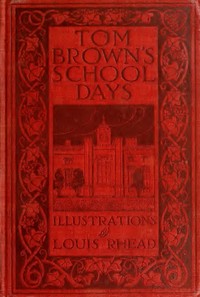
This digital edition of Tom Brown's School Days — Story, Setting & Ideas is described by source-level measurements including 111,498 words, 8 hr 5 min estimated reading time, and 14 detected text sections.
The text analysis averages about 23.9 words per sentence, while the detected sections provide another way to judge how the source is divided.
Project Gutenberg metadata also associates the work with “Schools -- Fiction,” connecting these edition facts with the source record’s subject description.
Explore this collection
These alternatives are selected using recorded categories and estimated reading time.
About 489 minutes
Historical Social Novels
112,357 recorded words. 4 minutes difference from this book's estimate.
View Gutenberg source #1587About 467 minutes
Historical Social Novels
107,271 recorded words. 18 minutes difference from this book's estimate.
View Gutenberg source #1923About 508 minutes
Historical Social Novels
116,822 recorded words. 23 minutes difference from this book's estimate.
View Gutenberg source #2559Search stored excerpts and compare books → Choose by your preferences →
Choices use stored catalog measurements. Estimates vary with reading speed. A shared category is a catalog label, not a claim that two books have the same argument or literary quality.
Search reads excerpt text stored with this catalog and links to its associated Gutenberg record. The connection is stored in the site database; this tool does not recheck that every excerpt is word-for-word identical to that external record. Excerpt search does not cover every chapter and does not verify historical publication dates.
Catalog snapshot checked: 2026-09-25. Coverage: 93 public books, 93 available source excerpts.
Read the complete public-domain text at its original source.
Read on Project GutenbergThomas Hughes's Tom Brown's School Days opens not with the boy himself but with a lengthy preface defending the novel's overt moralizing. The author admits he 'preaches and praises himself for preaching,' slipping into the drama to deliver sermons. This self-awareness sets the tone for a work that is as much about the shaping of character as about the scrapes and games of Rugby School. The excerpts reveal a world where rules are strict but their enforcement is erratic: fags must stay in their studies after supper, yet the hall becomes a clandestine gathering place for splicing bats and whispering. The tension between official discipline and boyish rebellion is embodied in the figure of Flashman, a bully who strikes without provocation and is ultimately challenged by Tom and his friend East.
The confrontation with Flashman in the hall is a set piece that reveals the school's informal justice. Flashman, described as 'strong and big' but 'in poor condition from his monstrous habit of stuffing,' represents a type of brute force that the system tolerates. Tom and East, though smaller, are 'tough boys of their age, and in perfect training.' The fight is not merely physical; it is a test of nerve. Diggs, an older boy, urges them on: 'you'll never get rid of that fellow till you lick him. Go in at him, both of you. I'll see fair play.' This moment crystallizes the code: boys must stand up to tyranny, and the community will enforce fairness. The narrator's approval is clear, but the scene also shows the precariousness of such justice—it depends on the courage of individuals and the tacit support of bystanders.
The excerpts detail a house rule that 'after supper all fags, except the three on duty in the passages, should remain in their own studies until nine o'clock.' Yet the narrator notes that 'the rule was stricter than its observance,' because most sixth-formers spent evenings in the fifth-form room. This gap between rule and practice creates a cat-and-mouse game: praepostors conduct 'district visiting' tours, and boys dive under sofas or pretend to study. The description of a raid—'the first kick at the door and ominous “Open here” had the effect of the shadow of a hawk over a chicken-yard'—is both comic and tense. Hughes uses this pattern to illustrate how boys learn to navigate authority, developing a pragmatic understanding of when to obey and when to evade. The system, for all its strictness, relies on a measure of tolerated disobedience.
Hughes does not let the story speak for itself. In the preface, he acknowledges that he 'talks the story out with many self-interruptions and excursions' and 'knows nothing of the modern method of letting it walk along on its own legs.' This intrusive narrator frequently steps in to comment on events, as when he explains that boys like Tom and East 'hadn't enough to do' because they could 'manage to get through pretty easily' their form work, leaving 'superfluous steam available for games and scrapes.' These asides serve as a running gloss on boy psychology, but they also slow the narrative. The effect is a hybrid of novel and moral essay, where the reader is never allowed to forget that the author is shaping the tale for a purpose. This technique, while dated, gives the book a distinctive, earnest tone.
Readers approaching Tom Brown's School Days should expect a work that is part adventure story, part conduct manual. The excerpts offer a microcosm of the whole: a world of fagging, football, and fights, where the narrator's voice is as prominent as the action. Pay attention to the moments when Hughes steps back from the story to explain a rule or a motive—these are where his educational project is most visible. The book rewards those who read it as a document of Victorian ideals of manliness and schooling, rather than as a straightforward novel.
Rereading Tom Brown’s School Days, I was struck by how much stock the narrator puts in a boy’s “character” being forged by school rules and scrapes. That quiet, stubborn belief in a fixed self, shaped early and carrying forward, reminded me suddenly of the careful inheritance talk in The Forsyte saga, Volume 1 — Context and Discussion. Both worlds feel so certain about what makes a man, even as the cracks show.
Build a private reading journal entry for this title.