About 837 minutes
Jane Eyre: An Autobiography — Edition Insights
Historical Social Novels
192,496 recorded words. 218 minutes difference from this book's estimate.
View Gutenberg source #1260
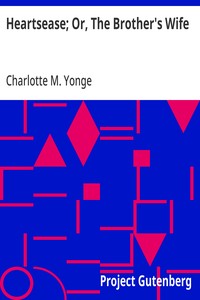
Heartsease; Or, The Brother's Wife — Context and Discussion can be approached with a clearer sense of reading commitment from its source measurements: 242,554 words, 17 hr 35 min estimated reading time, and 26 detected text sections.
The text analysis averages about 17.0 words per sentence, while the detected sections provide another way to judge how the source is divided.
Project Gutenberg metadata also associates the work with “England -- Social life and customs -- 19th century -- Fiction,” connecting these edition facts with the source record’s subject description.
Explore this collection
These alternatives are selected using recorded categories and estimated reading time.
About 837 minutes
Historical Social Novels
192,496 recorded words. 218 minutes difference from this book's estimate.
View Gutenberg source #1260About 824 minutes
Historical Social Novels
189,303 recorded words. 231 minutes difference from this book's estimate.
View Gutenberg source #4240About 1,339 minutes
Historical Social Novels
307,849 recorded words. 284 minutes difference from this book's estimate.
View Gutenberg source #1895Search stored excerpts and compare books → Choose by your preferences →
Choices use stored catalog measurements. Estimates vary with reading speed. A shared category is a catalog label, not a claim that two books have the same argument or literary quality.
Search reads excerpt text stored with this catalog and links to its associated Gutenberg record. The connection is stored in the site database; this tool does not recheck that every excerpt is word-for-word identical to that external record. Excerpt search does not cover every chapter and does not verify historical publication dates.
Catalog snapshot checked: 2026-09-25. Coverage: 93 public books, 93 available source excerpts.
Read the complete public-domain text at its original source.
Read on Project GutenbergThe novel opens with a detailed description of a sunlit park, where a young woman of 'princely port' teaches village children to make a cowslip ball, her coarse straw bonnet and plain dress contrasting with her regal bearing. This scene establishes a tension between natural aristocracy and social performance that runs through the excerpts. The catalog subjects list 'Upper class -- England -- Fiction' and 'Marriage -- Fiction,' but the excerpts show that class is enacted through small gestures—a child's 'bobbed curtsey,' a brother's concern over a waistcoat—rather than through grand statements. The narrative voice is attentive to physical details: the 'Skye terrier, like a walking door-mat,' the 'gold-coated flowers,' and the 'profuse black hair' of the heroine. These observations ground the story in a specific, material world.
The opening chapter introduces a heroine whose 'princely port' and 'stately head' are immediately remarked upon, yet her actions are entirely domestic: she teaches children to make a cowslip ball, and her dress is 'plain brown-holland.' This contrast between appearance and activity is a recurring motif. Later, in a conversation with her brother Albert, Violet insists she is 'perfectly happy' while he presses her about financial settlements and her standing with the Martindale family. The dialogue reveals a gap between Violet's public composure and private pressure. Albert's language—'you have a handsome establishment,—capital dinners, good turnout'—reduces marriage to material terms, while Violet's responses are evasive. The excerpts do not resolve this tension, but they show that the novel uses domestic scenes to examine the constraints on a woman's agency within upper-class marriage.
The subtitle 'The Brother's Wife' points to Violet's identity as defined by her husband's family. In the excerpts, she is addressed as 'Miss Martindale' by her own brother, and Theodora, her sister-in-law, 'accepts her as entirely Martindale, and not at all Moss.' This absorption into the husband's lineage is a central concern. The catalog subject 'Family -- England -- Fiction' is borne out by the intricate family dynamics: Theodora's protective care, Albert's intrusive advice, and Violet's careful management of her brother's manners. The novel's structure, divided into three parts with many chapters, suggests a slow unfolding of these relationships. The excerpts offer no plot resolution, but they indicate that the story will explore how a woman navigates her position between her birth family and her married one, with all the attendant expectations and vulnerabilities.
The excerpts are rich with objects that carry social meaning: a waistcoat 'to be worn on an occasion,' a cowslip ball, a 'coarse straw' bonnet, and 'plum buns' for village children. These details are not merely decorative; they signal class, occasion, and relationship. When Albert asks about 'the old aunt' and expectations from her, the conversation turns on inheritance and provision—material concerns that underpin the emotional drama. The catalog subject 'Marriage -- Fiction' is thus inflected by economic realities. The narrative voice is precise about these items, using them to reveal character and situation without explicit commentary. Readers attentive to such details will find a layered portrait of Victorian upper-class life, where a gesture as small as a 'smiling thanks' or a 'pull of the forelock' carries the weight of social hierarchy.
The excerpts from Heartsease offer a view into a novel that balances pastoral idealism with hard-edged domestic realism. Readers should attend to the interplay between the heroine's regal description and her constrained circumstances, and to the way objects and gestures carry the burden of social meaning. The incomplete text leaves many questions unanswered—about Violet's marriage, her brother's schemes, and her place in the Martindale family—but the careful construction of scene and dialogue invites patient, observant reading.
Reading about Violet’s quiet endurance among the grand country rooms made me think of my grandmother’s sitting room, where I first felt the weight of unspoken family duty. Two on a Tower — Context and Discussion stirred that same ache, the loneliness of a person bound by circumstance, staring at something vast and unreachable. Both books hold that hush between people who cannot say what they mean.
A brief reflection can help important ideas stay with you longer.