About 486 minutes
The Sea-Wolf — Key Ideas to Explore
Wandering Heroes Classic Adventures
111,601 recorded words. 4 minutes difference from this book's estimate.
View Gutenberg source #1074
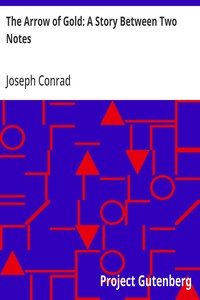
This digital edition of The Arrow of Gold: A Story Between Two Notes — Context and Discussion is described by source-level measurements including 112,550 words, 8 hr 10 min estimated reading time, and 9 detected text sections.
The text analysis averages about 16.0 words per sentence, while the detected sections provide another way to judge how the source is divided.
Project Gutenberg metadata also associates the work with “Sea stories,” connecting these edition facts with the source record’s subject description.
Explore this collection
These alternatives are selected using recorded categories and estimated reading time.
About 486 minutes
Wandering Heroes Classic Adventures
111,601 recorded words. 4 minutes difference from this book's estimate.
View Gutenberg source #1074About 501 minutes
Wandering Heroes Classic Adventures
115,188 recorded words. 11 minutes difference from this book's estimate.
View Gutenberg source #2360About 559 minutes
Wandering Heroes Classic Adventures
128,427 recorded words. 69 minutes difference from this book's estimate.
View Gutenberg source #1752Search stored excerpts and compare books → Choose by your preferences →
Choices use stored catalog measurements. Estimates vary with reading speed. A shared category is a catalog label, not a claim that two books have the same argument or literary quality.
Search reads excerpt text stored with this catalog and links to its associated Gutenberg record. The connection is stored in the site database; this tool does not recheck that every excerpt is word-for-word identical to that external record. Excerpt search does not cover every chapter and does not verify historical publication dates.
Catalog snapshot checked: 2026-09-25. Coverage: 93 public books, 93 available source excerpts.
Read the complete public-domain text at its original source.
Read on Project GutenbergJoseph Conrad’s The Arrow of Gold opens with a framing device that immediately foregrounds the act of remembering. A man writes to a childhood friend, confessing he will “succumb” to her request for his story, and the narrative that follows has been “pruned of all allusions to their common past.” This editorial note—that the text we read is a curated version of a longer manuscript—signals Conrad’s interest in how memory selects and shapes experience. The story proper begins in Marseilles during the mid-1870s, a setting tied to the Carlist cause, but Conrad’s focus is less on political intrigue than on the psychological and aesthetic textures of his characters’ encounters.
The novel’s structure is built on layers of mediation. The “First Note” explains that the pages come from a manuscript intended for one woman, the writer’s “childhood’s friend.” Conrad then presents the story as a response to her letter, but he has removed direct addresses and asides. This framing creates a double distance: we read a confession that is already edited, and we are aware of a listener whose reactions are withheld. The effect is to make the narrative feel both intimate and elusive, as if the reader is overhearing a tale meant for another ear.
Conrad’s dialogue is dense with social performance. In a long exchange with Mrs. Blunt, the narrator, Monsieur George, is subjected to a speech that veers from aesthetic theory to maternal ambition. Mrs. Blunt speaks of “the women of all time” and “the slave-owning woman who had never worked,” her tone oscillating between haughty and confiding. George’s responses are minimal—“I bowed my head in silence”—and his interior reactions are sharp: he feels “dumb,” “fascinated,” then “bitterness of contemptuous attention.” The conversation becomes a power struggle, with each pause and inflection carrying weight.
Conrad’s descriptive passages often carry thematic freight. Mrs. Blunt is described with “the perfect grace, the amazing poise of that venerable head, the assured as if royal—yes, royal even flow of the voice.” The repetition of “royal” and the phrase “slave-owning woman” link her aristocratic bearing to a specific, unapologetic worldview. Similarly, the narrator’s perception of her as “a mere slave of aesthetics” reveals his own ironic self-awareness. These descriptions do not merely set a scene; they encode judgments and tensions that drive the narrative forward.
The story is precisely located in time and place: Marseilles in the “middle years of the seventies,” during the Carlist insurgency. Yet Conrad insists that “it might have happened anywhere” while also granting that “the locality had a definite importance.” This paradox reflects his method: the setting provides a concrete stage for abstract conflicts of loyalty, honor, and desire. The novel’s subtitle, “A Story Between Two Notes,” hints at the epistolary frame, but the action is rooted in the physical world of the Mediterranean port, with its political exiles and clandestine arms deals.
Readers should attend to the gaps in the narrative—the silences, the withheld reactions, the edited allusions. Conrad’s prose rewards careful attention to diction and rhythm, especially in dialogue where characters reveal themselves through what they choose to say and what they leave unsaid. The novel is not a straightforward adventure but a study in how a story is told and what it costs to tell it.
The Arrow of Gold’s framed memories made me think of long summer evenings spent half-listening to old stories, where every detail feels both urgent and already lost. It has that same creaking, tide-bound patience I remember from The Riddle of the Sands — Text and Context, another book that never rushes its own uneasy quiet.
Capture what you thought, learned, and would like to remember.