About 490 minutes
The Arrow of Gold: A Story Between Two Notes — Context and Discussion
Wandering Heroes Classic Adventures
112,550 recorded words. 11 minutes difference from this book's estimate.
View Gutenberg source #1083
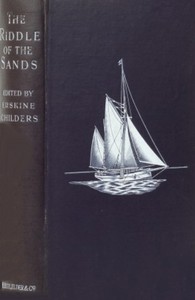
Before opening The Riddle of the Sands — Text and Context, the edition data offers a quick orientation: 115,188 words, 8 hr 21 min estimated reading time, and 34 detected text sections.
The text analysis averages about 17.6 words per sentence, while the detected sections provide another way to judge how the source is divided.
Project Gutenberg metadata also associates the work with “Sea stories,” connecting these edition facts with the source record’s subject description.
Explore this collection
These alternatives are selected using recorded categories and estimated reading time.
About 490 minutes
Wandering Heroes Classic Adventures
112,550 recorded words. 11 minutes difference from this book's estimate.
View Gutenberg source #1083About 486 minutes
Wandering Heroes Classic Adventures
111,601 recorded words. 15 minutes difference from this book's estimate.
View Gutenberg source #1074About 559 minutes
Wandering Heroes Classic Adventures
128,427 recorded words. 58 minutes difference from this book's estimate.
View Gutenberg source #1752Search stored excerpts and compare books → Choose by your preferences →
Choices use stored catalog measurements. Estimates vary with reading speed. A shared category is a catalog label, not a claim that two books have the same argument or literary quality.
Search reads excerpt text stored with this catalog and links to its associated Gutenberg record. The connection is stored in the site database; this tool does not recheck that every excerpt is word-for-word identical to that external record. Excerpt search does not cover every chapter and does not verify historical publication dates.
Catalog snapshot checked: 2026-09-25. Coverage: 93 public books, 93 available source excerpts.
Read the complete public-domain text at its original source.
Read on Project GutenbergThe Riddle of the Sands presents itself as a factual record, edited by Erskine Childers from his friend “Carruthers’s” narrative. This framing device immediately establishes a tension between documentary truth and fictional adventure. The story’s engine is not merely espionage but the strained partnership between Carruthers, a cynical Foreign Office clerk, and Davies, a passionate yachtsman. Their differing temperaments—one calculating, the other impulsive—drive both the plot and the book’s deeper interest in how trust is built and tested under pressure.
The opening chapters establish Carruthers as a reluctant recruit. He is lured to the Dulcibella under false pretenses, expecting a comfortable cruise, and instead finds a cramped, workaday yacht. Davies’s single-minded obsession with channels and tides strikes Carruthers as eccentric, even fanatical. Yet the narrative voice—Carruthers’s own—is wry and self-aware, admitting his own vanity: “I couldn’t resist adding this” about liking yachting. This early friction is not smoothed over; it becomes the book’s central dynamic. The two men must negotiate a working relationship while hiding their true purpose from each other and from the Germans they investigate.
A key excerpt reveals a crisis of conscience. Davies has concealed his feelings for Dollmann’s daughter, and Carruthers accuses him of poor judgment: “Your manner when they were mentioned was so confused as to imperil our whole position.” The dialogue is taut, with Carruthers pressing for “the bare, matter-of-fact truth” while Davies struggles to admit “I did like her—very much.” This personal entanglement complicates the mission. Carruthers proposes abandoning the plan; Davies refuses, torn between duty and affection. The scene exposes the human cost of espionage, where every strategic decision carries emotional fallout.
The book’s structure mirrors its setting: a maze of shallow channels and hidden sandbanks. The table of contents lists chapters like “The Missing Page” and “The Little Drab Book,” hinting at clues that must be pieced together. The narrative itself proceeds by indirection—Carruthers and Davies gather intelligence through observation and deduction, not direct confrontation. The reader, like the protagonists, must interpret ambiguous signals: a chart, a torn page, a commander’s too-friendly hospitality. This methodical accumulation of detail rewards close attention, especially to the physical environment of the Frisian Islands, which is rendered with precise nautical terminology.
Readers should attend to the book’s dual nature: it is both a suspenseful adventure and a study in how two very different men learn to trust each other. The sailing details are not mere decoration but integral to the plot’s logic. Pay particular attention to the moments when Carruthers’s polished irony gives way to genuine unease—those shifts mark the story’s deepest concerns about loyalty, duty, and the price of secrecy.
Rereading the 1903 novel made me dwell on how its quiet, technical dread feels inseparable from a certain khaki-and-sunlight romance. Those windswept Frisian sands somehow bring back the darker pulse beneath Haggard’s African plains—both stories wrestling with buried threats and unspoken loyalties. It left me holding King Solomon's Mines — Themes and Context, wondering if every adventure hides a quieter betrayal beneath its compass bearings. Just a passing thought.
Save your reaction, strongest insight, and memorable passage.