About 381 minutes
The Elusive Pimpernel — Key Ideas to Explore
Wandering Heroes Classic Adventures
87,522 recorded words. 3 minutes difference from this book's estimate.
View Gutenberg source #2785
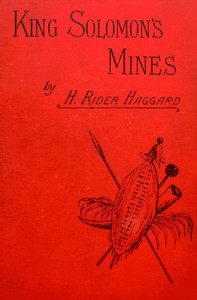
Before opening King Solomon's Mines — Themes and Context, the edition data offers a quick orientation: 86,759 words, 6 hr 18 min estimated reading time, and 24 detected text sections.
The text analysis averages about 21.0 words per sentence, while the detected sections provide another way to judge how the source is divided.
Project Gutenberg metadata also associates the work with “Africa -- Fiction,” connecting these edition facts with the source record’s subject description.
Explore this collection
These alternatives are selected using recorded categories and estimated reading time.
About 381 minutes
Wandering Heroes Classic Adventures
87,522 recorded words. 3 minutes difference from this book's estimate.
View Gutenberg source #2785About 364 minutes
Wandering Heroes Classic Adventures
83,714 recorded words. 14 minutes difference from this book's estimate.
View Gutenberg source #3782About 341 minutes
Wandering Heroes Classic Adventures
78,276 recorded words. 37 minutes difference from this book's estimate.
View Gutenberg source #2876Search stored excerpts and compare books → Choose by your preferences →
Choices use stored catalog measurements. Estimates vary with reading speed. A shared category is a catalog label, not a claim that two books have the same argument or literary quality.
Search reads excerpt text stored with this catalog and links to its associated Gutenberg record. The connection is stored in the site database; this tool does not recheck that every excerpt is word-for-word identical to that external record. Excerpt search does not cover every chapter and does not verify historical publication dates.
Catalog snapshot checked: 2026-09-25. Coverage: 93 public books, 93 available source excerpts.
Read the complete public-domain text at its original source.
Read on Project GutenbergKing Solomon's Mines moves its characters through a series of sharply defined physical spaces: the dry desert, the mountain pass, the kraal of King Twala, and the underground treasure chamber. Each setting imposes its own constraints on the party—thirst, cold, political danger, or darkness—and the narrative rhythm depends on the group's ability to adapt. The novel's structure is essentially episodic, with each chapter introducing a new obstacle or discovery, from the elephant hunt to the witch-hunt to the final flight from the collapsing cave.
The narrative proceeds as a series of distinct stages, each with its own geography and tension. The party moves from the familiar (a Natal hunting trip) into the unknown desert, then through a mountain pass into Kukuanaland, then through political intrigue and battle, and finally into the treasure cave. Each stage is marked by a change in the characters' immediate goal: survival, diplomacy, warfare, escape. The chapters are short and action-driven, with little time spent on reflection. This structure gives the novel a forward momentum that mirrors the physical journey itself.
Throughout the excerpts, light sources are carefully noted: the lamp made from palm fibre and hippopotamus fat, the dim light of the hut, the darkness of the night after the witch-hunt. These details are not merely atmospheric; they signal shifts in power and knowledge. In the treasure chamber, the characters' lanterns reveal the glitter of diamonds and gold, but also the skeletons of previous seekers. The contrast between the bright, open desert and the enclosed, shadowy kraal reinforces the theme of visibility versus concealment—what can be seen and what remains hidden.
The Kukuanaland setting is not a backdrop but an active force. The desert crossing tests the party's endurance; the mountain pass, with its ancient road and colossal statues, suggests a lost civilization. The kraal is a space of ritual and violence, where the witch-hunt unfolds under the king's gaze. The treasure cave is both a goal and a trap, its stalactites and darkness threatening to entomb the explorers. Haggard describes these places with concrete physical details—the texture of rock, the taste of water, the heat of the sun—grounding the adventure in sensory experience.
The narrative frequently shifts between large, public scenes (the witch-hunt, the battle) and intimate, private ones (the hut conversations, the quiet moments before dawn). In the public scenes, the characters are performers, subject to the gaze of the Kukuana crowd; in the private scenes, they strategize and reveal their fears. This alternation creates a rhythm of tension and release. For example, after the horror of the witch-hunt, the party retreats to their hut, where they can speak freely and plan their next move. The hut becomes a space of safety and alliance, in contrast to the exposed kraal.
Readers attentive to the novel's structure will notice how Haggard uses the journey itself as a organizing principle, with each new location introducing a fresh set of rules and risks. The recurring images of light and darkness, and the careful alternation between public spectacle and private conference, give the adventure a shape that rewards close attention to setting and scene transitions.
Some stories sit with you like a place you once walked, and that underground journey through shifting light and stone felt that way. It made me think of another quiet book, The Pioneers; Or, The Sources of the Susquehanna — A Reader’s Guide, where the landscape itself seems to hold the memory of every step. There’s a stillness there that lingers long after the last page turns.
Answer a few questions and save a private reflection on this device.